Artificial snow and the climate crisis
Artificial snowmaking has become the backbone of Alpine ski tourism. But the climate crisis is driving up water and energy consumption, while the window of opportunity for snow production is shrinking. A recent CIPRA report shows that technical climate adaptation is increasingly reaching its limits.
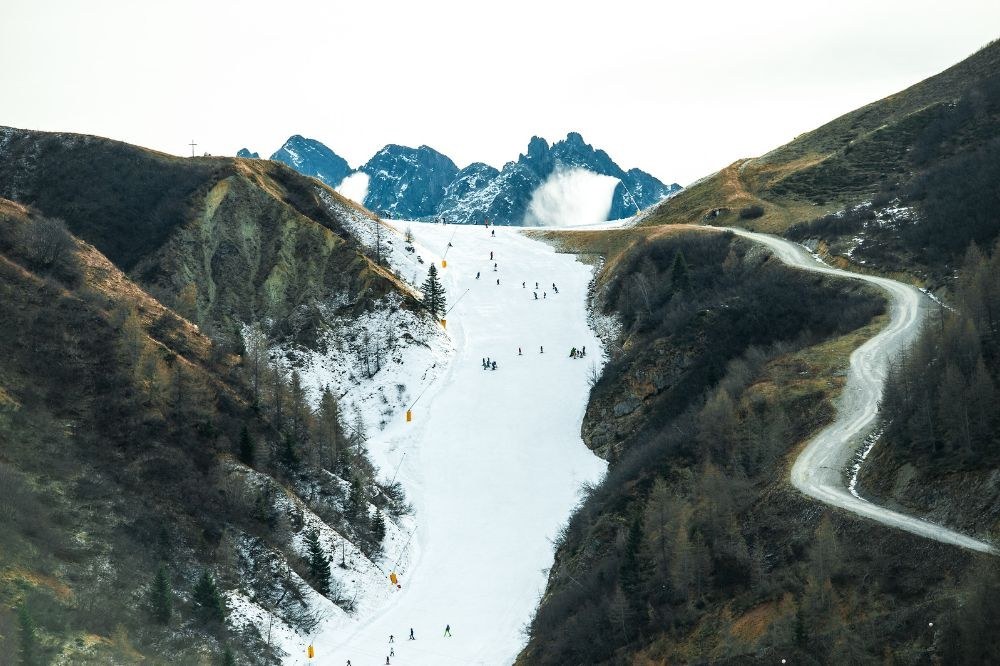
What once began as a supplement to natural snow has now become a prerequisite for operation at many ski resorts. At the same time, the climate crisis is profoundly changing the Alps: temperatures are rising, the snowpack is lasting for shorter and shorter periods, and the snowline is shifting higher. A recent CIPRA report summarises current figures, data, and facts on artificial snow. Today, more than 62,000 hectares of slopes across the Alps are covered with artificial snow. This requires approximately 190 million cubic metres of water per season – the same as around four million people consume in their households each year. Added to this is an annual electricity consumption of approximately 1,000 to 2,250 gigawatt-hours, corresponding to the needs of up to 560,000 central European households.
Less and less time for snowmaking
Too much rain, too little snow, and a growing mountain of debt: despite investments in artificial snow production, the ski lifts at Kolbensattel/D ceased operations in 2026. Similar examples can be found throughout the Alps. Artificial snow can only be produced at low temperatures: the window of opportunity for this is shrinking, while water and energy demands are rising. New reservoirs mean ecological impacts on Alpine landscapes and soils, and longer dry spells are exacerbating conflicts over water use, e.g. with drinking water supplies and agriculture. Christine Busch, co-author of the report and executive director of CIPRA Germany, says: “The future of winter tourism does not lie in ever-increasing amounts of artificial snow. Nor is this compatible with the Alpine Convention, in which the Alpine countries commit to sustainable tourism development through environmentally sound tourism. What is needed are long-term strategies that bring together climate protection, adaptation to climate change, and the protection of Alpine ecosystems”. According to Busch, there needs to be greater transparency regarding water and energy consumption, Alpine-wide monitoring of snowmaking and a stronger focus in winter tourism on climate-resilient offerings.
The report “Artificial Snowmaking in the Alps” is available in English and German.
Podcast talk with Christine Busch:
Further information
CIPRA Report: Artificial Snowmaking in the Alps