Transit traffic reaches its limits
Ensuring cost fairness, reducing journey numbers, shifting to rail: some 200 participants at the CIPRA Annual Conference, held in mid-October 2026 in Bolzano, Italy, discussed ways to limit the rising volume of traffic in the Alps.
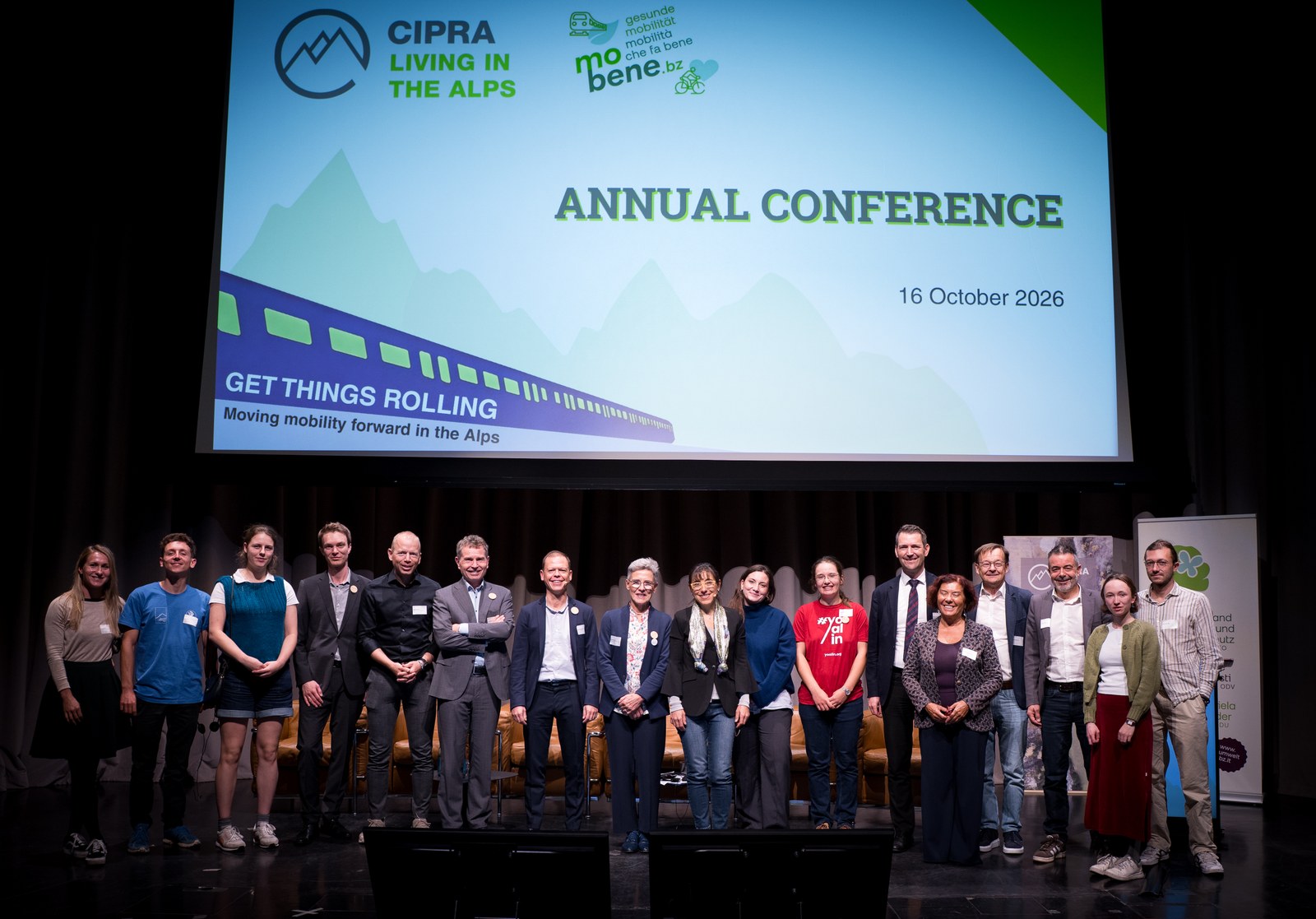
Every year, some 2.5 million trucks and 9 million cars cross the Alps on the Brenner autobahn alone, and the trend is increasing. “Traffic has become a burden on people and nature”, stated Elisabeth Ladinser, president of CIPRA South Tyrol – the umbrella organisation for nature and environmental protection – at the opening of the CIPRA Annual Conference in Bolzano, Italy. She emphasised that joint solutions are needed to make mobility more sustainable. Claudio Corrarati, Mayor of Bolzano, also stressed the need for sustainable solutions and difficult political decisions.
Switzerland is considered a role model for shifting freight transport onto rail. Through the Alpine Initiative, the population has enshrined this goal in the constitution, which is complemented by distance- and weight-based tolls for trucks. Nevertheless, truck traffic is on the rise again. “There is a lack of political will to implement existing measures in a consistent way”, explained Nara Valsangiacomo, president of Pro Alps, in her presentation.
Shift or avoid?
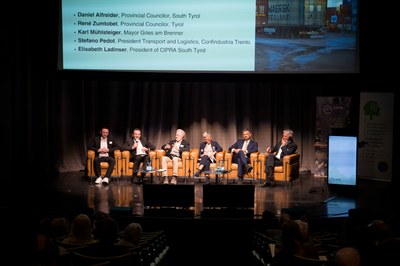
The panellists agreed that more freight should be transported by rail. The question of whether there should be less traffic overall remained a point of contention. South Tyrol’s Provincial Councillor for Mobility, Daniel Alfreider, emphasised the central role of the Brenner Base Tunnel. However, he noted that this would require the expansion of the rail lines between Munich, Germany, and Verona, Italy. René Zumtobel, Provincial Councillor for Austrian Tyrol, also warned that without the necessary feeder lines, the tunnel would risk becoming a “heart without arteries”. He also called for greater cost fairness and a more equitable distribution of transit traffic over the Alpine crossings: “If three out of ten trucks have to take a 120-kilometre detour, then something is wrong with the system.”
“We need a paradigm shift in the economy”, demanded Elisabeth Ladinser. Traffic is one of the biggest sources of greenhouse gas emissions, she noted, while at the same time last summer in the Alps was hotter than ever before. The climate crisis calls for a more circular economy and a more conscious approach to goods flows and consumption. Together with Karl Mühlsteiger, Mayor of Gries am Brenner, she called for a reduction in transit traffic. Mühlsteiger summed up the perspective of the communities affected: “People’s health must take precedence over the free movement of goods.”
Mobility: the gap between policy and practice
In her presentation, Anna Donati, President of “Roma Servizi per la Mobilità,” highlighted how the lack of a national mobility strategy is taking a toll on the Alpine region. Martin Vallazza, director of the Infrastructure and Mobility Department of the Autonomous Province of Bolzano, presented South Tyrol’s transportation roadmap. This includes, among other things, a visitor card, investments in rail infrastructure, and the electrification of the Vinschgau railway. In six different masterclasses, participants discussed socially equitable mobility, bike paths suitable for everyday use, and climate-friendly street spaces. Excursions to the Brenner Base Tunnel and the Ritten aerial ropeway provided practical insights on the following day.