
Mercosur Agreement : what is at stake for Alpine pastoralism ?
The EU opened a new competitive market back in May 2026 with four South American countries: Argentina, Brazil, Paraguay and Uruguay. This sparked many heated debates within the EU with France leading the way. Many European stakeholders question the extent to which European markets should open their markets to globalisaton, especially regarding agricultural production and goods. Indeed, the EU has one of the strictest regulations in terms of quality control, pesticides and antibiotics use. Increased competition and diversification but at what cost for the pastoral economy?
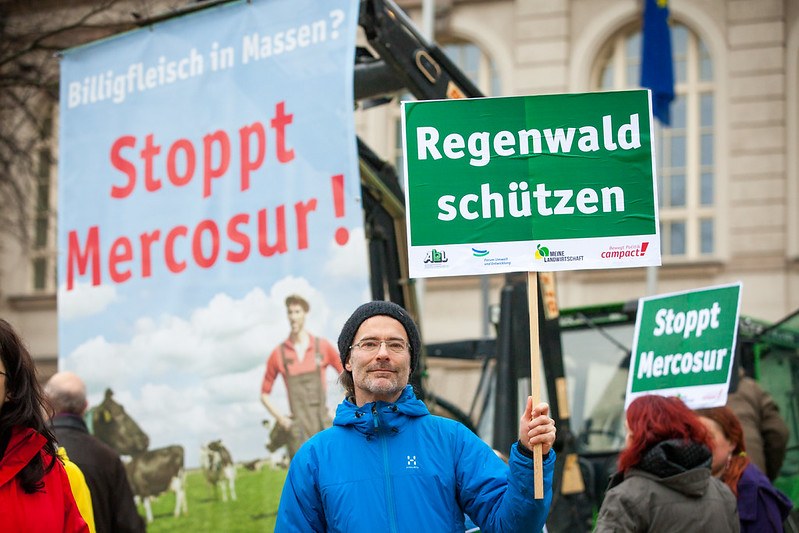
As the European Union tied the knot with Argentina, Brazil, Uruguay and Paraguay through the EU-Mercosur agreement in January 2026, the agricultural sector strongly affirmed its disapproval. In Europe, food norms are among the strictest for health and environmental reasons. However, many norms are not imposed with the same severity on the Mercosur countries. This lack of reciprocity principle was at the heart of many heated debates, especially led by France. They seemed to have been right to worry as this late August, the EU announced a ban on beef importation from Brazil due to intensive use of antibiotics. An ongoing audit will confirm or deny the expansion of this ban to honey and poultry products. It is well documented that over-consumption of antibiotics creates a resistance and therefore affects consumers’ health. These past years, the World Health Organisation recorded a spike in death caused by resistant infections to medication. The agency stated that super-bacteria resisting to macrobiotics contributed to an additional 5 millions deaths each year.
In 2025, Brazil exported more than 92 000 tons of beef-related products, representing more than €713 millions. Dominique Fayel, the president of the French Bovine National Federation compared Brazil’s agricultural model to China’s industrial one, stating that the French family-based farms couldn’t compare to Brazilian 10 000 to 20 000-hectares farms. This is especially true for pastoralism due to a 40% decrease of productivity compared to lowland farms due to mountain environment and its natural constraints. Thus, meat production in the Alps is inherently threatened by the EU-Mercosur agreement on national and EU markets. The only response that all farmers have received from Bruxelles is a promise to unlock €45 billions in anticipation on the next 2028-2034 PAC budget to face the upcoming strengthened competition. No declaration has been made regarding mountain agriculture. Yet, Dominique Fayel has agreed to shed light on a few points. If prices are expected to be impacted across all geographical areas, mountain agriculture will still be unequally touched due to its specificity.
Additionally, alpine agriculture highly depends on labels that are markers of quality and geographical savoir-faire. These labels are not equally distributed across regions, in instance labeled dairy production is more concentrated in the Alps than in the Massif Central. Dominique Fayel underlines that inflation has started to become an issue in the past years since consumers had to reduce their consumption of some products or shift their preference towards cheaper options. For example, in France, the cheese production of Comté has recently been reduced, something that has not happened in decades. Due to the introduction of more competitive products from South-American countries, this inflation could lead consumers to shift their preference away from local producers. For example, in 2025, average beef meat in Europe was 7€/kg against half the price in Brazil.
However, lower demand cannot question the positioning and usefulness of mountain agriculture since rangelands valorisation can only be achieved through livestock farming. Biodiversity and climate-wise it is therefore crucial that mountain agriculture is still supported by European policies such as the PAC. Agricultural production under mountain conditions are already not competitive on the global market and will therefore require necessary adaptations.
On the other hand, Chatellier (2026) dived into the different Free Trade Agreements (FTA) that were signed a few years ago with the UK, Canada and Ukraine a few years ago. His analysis highlights an economic stability in trade between the EU and these countries. Trends are quite favorable and have been increasing. There exists provisions in these agreements that protect the European agrifood system, especially smaller sectors, thanks to importation quotas or a reciprocity principle that requires EU’s trading partners to match with the EU’s environmental and sanitary regulations in order to import their goods on European ground. If such clauses were to be exemplified and ratified, it would protect the sector from unfair competition and ensure further economic stability in mountain regions. European farmers are therefore waiting for additional provisions from the EU to protect their business models in the wake of the arrival of agricultural giants on European markets.
Finally, the debate is not strictly economic as biodiversity is largely put under pressure through this agreement. It could drive up the beef demand and production which would put additional pressure on land. Land-changes are one of the primary factors of biodiversity loss. Additionally, the EU has implemented strict legislation (EUDR) to limit importation of products linked to deforestation. However, NGOs are concerned by the potential weakening of regulation enforcement, especially regarding control, traceability and sanctions, due to trade mechanisms.
Sources :
Chatellier, Vincent. « Les échanges de l’Union européenne en produits animaux et les effets de trois accords commerciaux (Royaume-Uni, Ukraine, Canada) ». INRAE Productions Animales, vol. 39, no 1, mars 2026, p. 9520‑9520. productions-animales.org, https://doi.org/10.20870/productions-animales.2026.39.1.9520.
Interview with Dominique Fayel, Vice President of Euromontana and president of the French Bovine National Federation, 21 October 2026.
Ledroit, Valentin, et Valentin Ledroit Lesur Alexandra. « Colère et manifestations des agriculteurs : pourquoi l’accord entre l’UE et le Mercosur pose problème ». Touteleurope.eu, 20 janvier 2026, https://www.touteleurope.eu/agriculture-et-peche/colere-des-agriculteurs-pourquoi-l-accord-avec-le-mercosur-pose-probleme/.
« L’Union européenne annonce suspendre ses importations de viande brésilienne à partir de jeudi ». Le Monde, 31 août 2026. Économie,Brésil. Le Monde, https://www.lemonde.fr/economie/article/2026/08/31/l-union-europeenne-annonce-suspendre-ses-importations-de-viande-bresilienne-a-partir-de-jeudi_6762819_3234.html.
Mauuarin, Marion. « EU-Mercosur Agreement: A “Free Trade” Agreement That Puts Biodiversity and Climate under Pressure ». Noé, 13 janvier 2026, https://noe.org/en/accord-ue-mercosur-un-libre-echange-qui-met-la-biodiversite-et-le-climat-sous-pression/.
« Mercosur : l’accord de libre-échange sera appliqué provisoirement à partir du 1er mai ». Le Monde, 23 mars 2026. Économie,Accord UE-Mercosur. Le Monde, https://www.lemonde.fr/economie/article/2026/03/23/mercosur-l-accord-de-libre-echange-sera-applique-provisoirement-a-partir-du-1er-mai_6673909_3234.html.
Palmieri, Rossella, et al. « Beyond the Finish Line: Sustainability Hurdles in the EU–Mercosur Free Trade Agreement ». Social Sciences, vol. 13, no 7, juillet 2024, p. 362. DOI.org (Crossref), https://doi.org/10.3390/socsci13070362.