Collapsing Alpine glaciers
Austria’s ice giants are shrinking rapidly and literally crumbling away; Germany will soon be ice-free. Research shows that retreating glaciers mean we are losing not only water reservoirs, but also archives of human history.
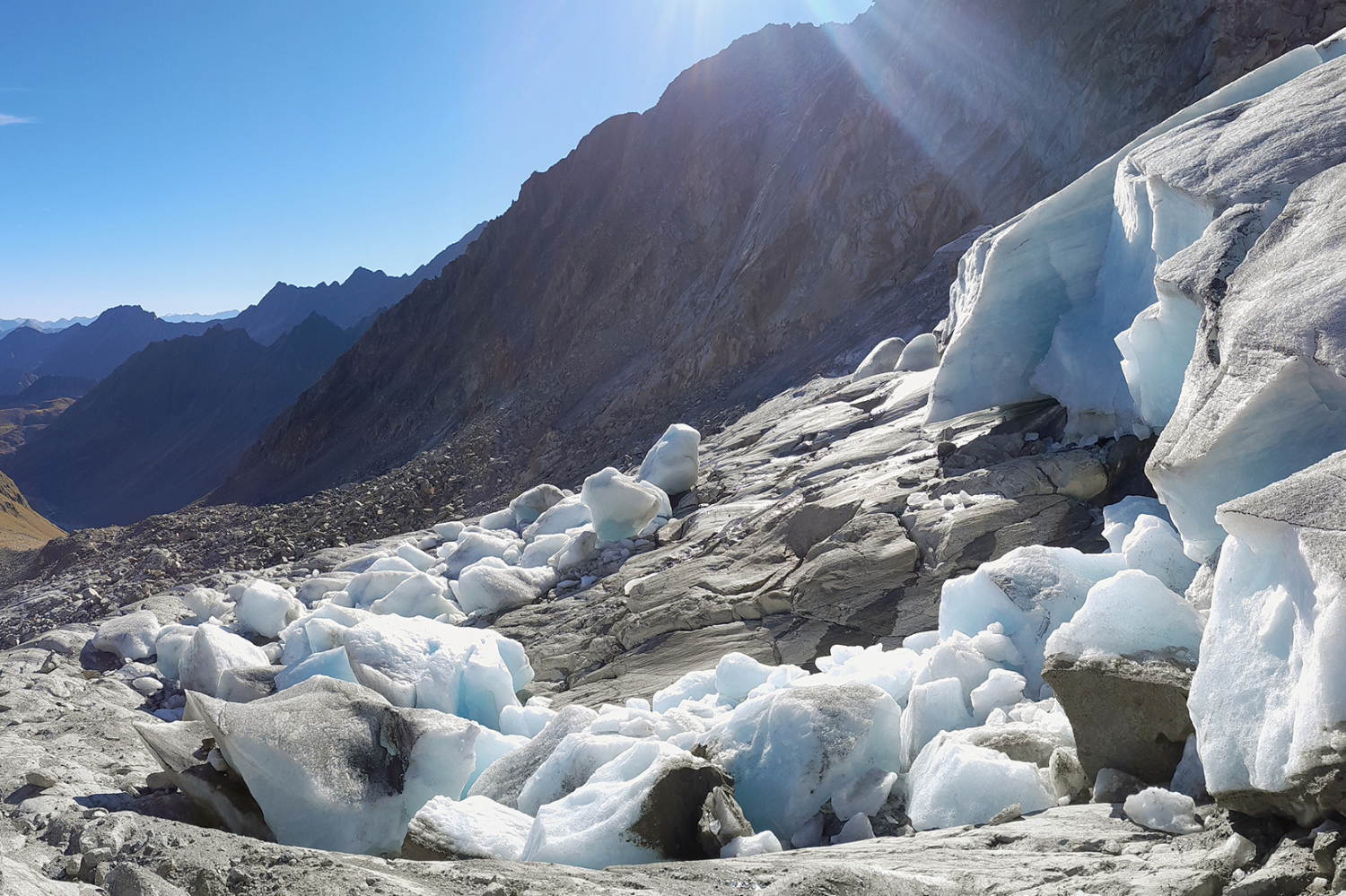
An average of 20 metres and, in some places, up to 100 metres: this is how much Austria’s glaciers have receded between 2024 and 2025. It is striking that many glaciers are not only losing length, but are also entering a phase of structural disintegration. Rock steps are being exposed as the ice melts away, sections of ice are breaking off, and glacier tongues are collapsing. In light of the latest figures on glacier melt, the Austrian Alpine Club is calling for effective climate policy and a re-evaluation of our own behaviour, as glacier melt is a direct consequence of climate change. Temperatures are rising particularly sharply in the Alpine region: in Austria, the rise in temperature has already exceeded the forecasts of the 2015 climate scenarios. In Germany, too, the consequences of climate change are evident in the glaciers; by the 2030s, its last four glaciers will also have melted. Germany’s only glacier ski resort was lost only recently: the instability caused by rising temperatures has led to the dismantling of the lift at the Nördlicher Schneeferner on the Zugspitze.
Melting archive, vanishing water reservoir
It is not only tourism infrastructure that is disappearing with the glaciers, but also valuable water reservoirs, unique habitats and an archive of human history. Preserved in tiny air bubbles, particles and traces, glacial ice holds the history of Europe, from the Romans to the modern era. Researchers from Italy, Austria and Germany were able to confirm this using an ice core from the Ötztal Alps. Their aim is to extract as much information as possible from the ice before it is irretrievably lost. Does glacier melt threaten our water supply? This is the focus of the Austrian research project “Water in Climate Change”. The loss of glaciers as water reservoirs is altering water availability, and water shortages could occur in summer, particularly in high-alpine catchment areas. The researchers therefore emphasise that it is important to take timely precautions and implement adaptation measures.
Sources and further information:
https://science.orf.at/stories/3234667/ (de), www.alpenverein.at/portal/service/presse/2026/2026_03_13_gletscherbericht.php (de), www.handelsblatt.com/technik/forschung-innovation/klimakrise-rekordschmelze-deutschland-wohl-in-2030ern-ohne-gletscher/100209911.html (de), www.fr.de/wissen/klimakrise-bedroht-alpengletscher-eisiges-archiv-der-menschheitsgeschichte-schmilzt-94235868.html (de), https://science.orf.at/stories/3235081/ (de), www.eurekalert.org/news-releases/1117806 (en), www.popsci.com/environment/alpine-glacier-ice-melting-history/ (en), www.euronews.com/video/2026/03/23/disappearing-glacier-forces-demolition-of-ski-lift-on-germanys-highest-mountain (en)
Further information