A Strained Planet
We are living beyond our means: by spring, the Alpine countries have already used up their annual resources. “Overshoot Day” is coming earlier and earlier in the calendar, but there are ways to change this.

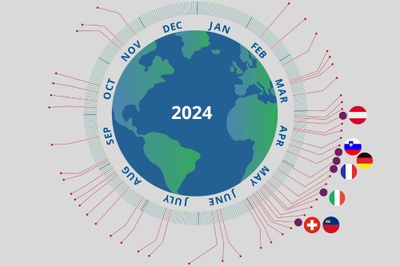
Earth Overshoot Day is calculated annually by the Global Footprint Network. It marks the day on which humanity has used up the resources that the Earth can regenerate within a year. Every year, this day moves further forward in the calendar – and with it the national “Overshoot Days”: Austria, for example, had already used up its resources by 2 April, France by 24 April, Italy by 3 May, Germany by 10 May, and Switzerland and Liechtenstein by 11 May. Year after year, the demand for resources is rising – from plant-based foods and fibres such as cotton to animal products, timber, and land for infrastructure and settlements. In addition, more and more forest area is needed to absorb the CO₂ emitted primarily by fossil fuels. Calculations show that industrialised nations in particular are living beyond their means: if everyone were to use as many resources as those in the small Alpine country of Austria, four Earths would be needed.
Small countries, big contribution
Yet there are many levers that can be used to reduce resource consumption and thus push Earth Overshoot Day further back, says Werner Pohl, Co-President of the SDG Alliance Liechtenstein: “Even small Alpine countries such as Austria, Switzerland, Slovenia or Liechtenstein can make an essential contribution.” The SDG Alliance is committed to implementing the UN Sustainable Development Goals and brings together numerous stakeholders from civil society, politics and business, including CIPRA. “Earth Overshoot Day is not about scaremongering; it is simply intended to raise awareness and make clear: we only have this one planet. We definitely have the intelligence to overcome today’s challenges”, says Pohl. Examples include reducing food waste, increasing the consumption of local products, adopting regenerative construction practices, expanding solar and wind energy, promoting e-mobility, and learning from good examples in other countries.
Sources and further information:
www.derstandard.at/story/3000000314804/weltersch246pfungstag-214sterreich-hat-den-overshoot-day-erreicht (de), www.momentum-institut.at/news/weltueberlastungstag-am-2-april-ist-oesterreichs-ressourcen-budget-verbraucht/ (de), www.srf.ch/play/tv/10-vor-10/video/earth-overshoot-day-wie-nachhaltigeres-leben-aussehen-koennte?urn=urn%3Asrf%3Avideo%3A35f387c4-2a60-4e4a-a600-d3edc4244177 (de), https://pro.earth/2026/04/02/earth-overshoot-day-oesterreich-hat-heute-alle-natuerlichen-ressourcen-eines-jahres-verbraucht/ (de), www.earthday.it/6-maggio-overshoot-day-italiano/ (it), https://economiacircolare.com/overshoot-day-italia-2026/ (it), www.ardalpha.de/wissen/umwelt/nachhaltigkeit/earth-overshoot-day-welterschoepfungstag-klima-oekologischer-fussabdruck-100.html (de), https://grandparentsforclimate.eu/country-overshoot-day-2026/ (en)
Podcast interview with Werner Pohl (de):
Further information